
Topics to be covered in this post are:
- Data Ingestion –> Real-time data collector
- Data Storage –> Scalable data holder
- Azure Synapse Analytics –> Data analyzer and warehouse
- Azure HDInsight –> Big data batch processor
- Azure Databricks –> Fast processor and ML engine
- Synapse Pipeline –> Data flow manager
- Stream Processing –> Real-time analyzer
- Batch Processing –> Historical data analyzer
- Machine Learning –> Traffic predictor
- Visualization –> Insight presenter
For instance, in Smart Traffic Management Using Azure, in the present day scenario, traffic jams are common problems faced by cities because of the rise in the number of vehicles and conventional traffic signals that cannot be adjusted based on the current traffic situation. The traditional traffic signal works on predefined time settings and does not change based on the flow of traffic. Consequently, drivers end up wasting fuel and contributing to pollution.
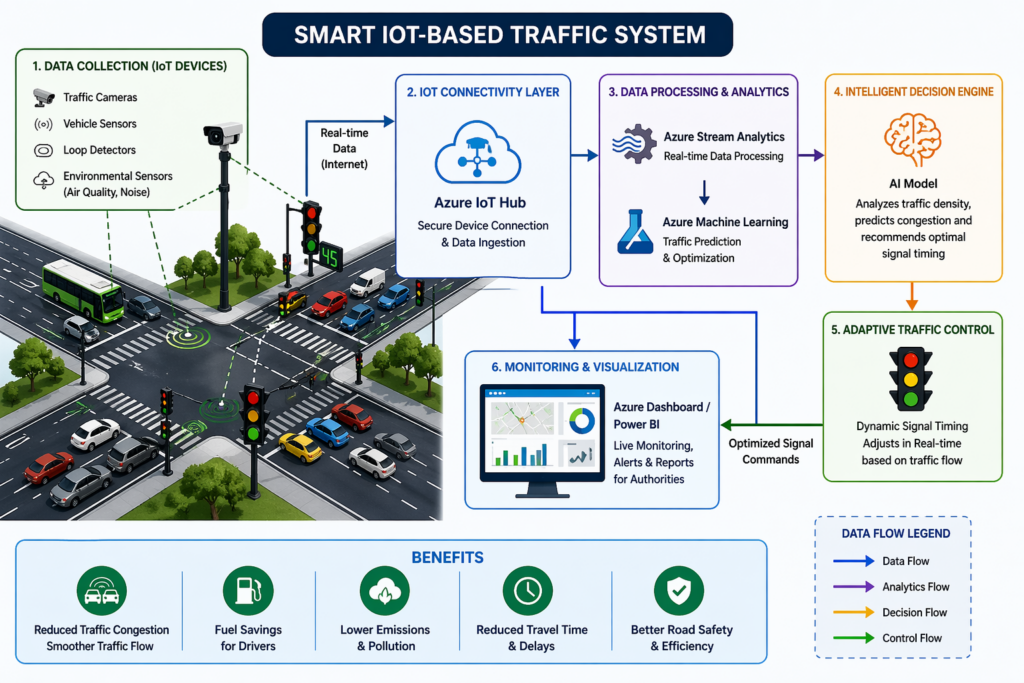
Data Collection (Ingestion Layer)
Step one in this system involves data collection from live traffic. The sensors placed on the roads as well as cameras mounted at junctions constantly observe the movement, velocity, and density of vehicles passing through those areas. The information gathered from such sensors and cameras is transmitted to the cloud through Azure IoT Hub and Azure Event Hubs. In this step, there is data ingestion, whereby huge amounts of data are collected live.
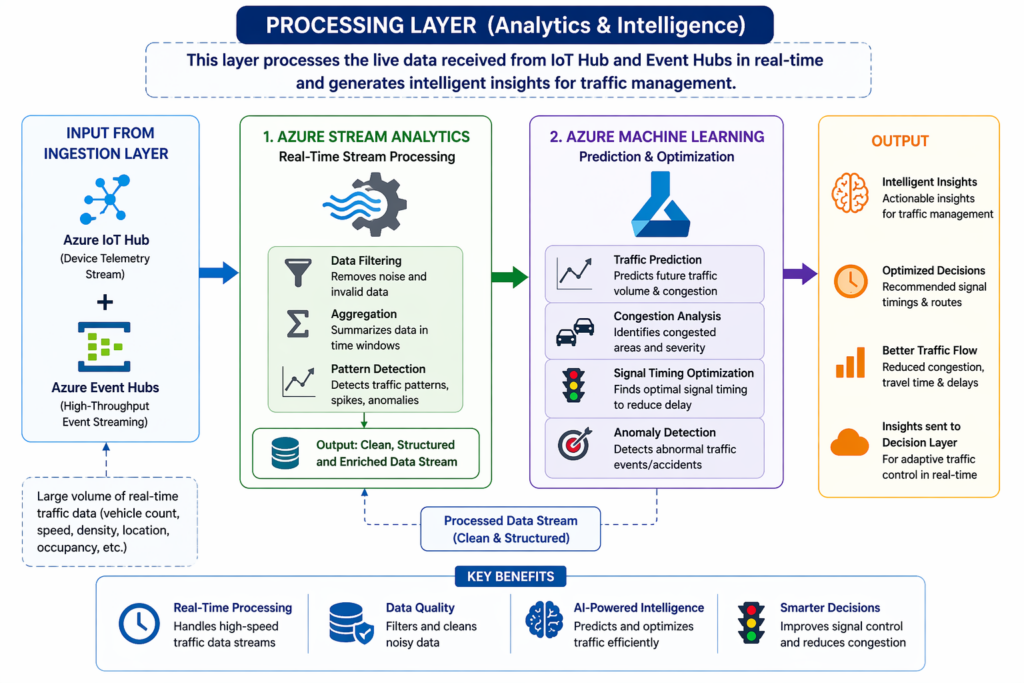
Data Storage (Data Lake Layer)
Once data collection has been accomplished, storage must be considered in order to facilitate further manipulation of the data. Azure Blob Storage and Azure Data Lake Storage are utilized for storing large volumes of unstructured data, including videos and sensor data. Both technologies provide scalability while enabling the storage of real-time data as well as historical data. This is the basis of the Big Data infrastructure.
Azure Blob Storage is a highly scalable and cost-effective object storage solution designed to store massive amounts of unstructured data such as images, videos, logs, and backups. One of its key characteristics is its ability to handle large volumes of data with high durability and availability, ensuring that data is safely replicated across multiple locations.
Azure Data Lake Storage is specifically designed for big data analytics workloads and is built on top of Azure Blob Storage. Its main characteristic is its ability to store both structured and unstructured data in a hierarchical file system, making it easier to organize and manage large datasets.
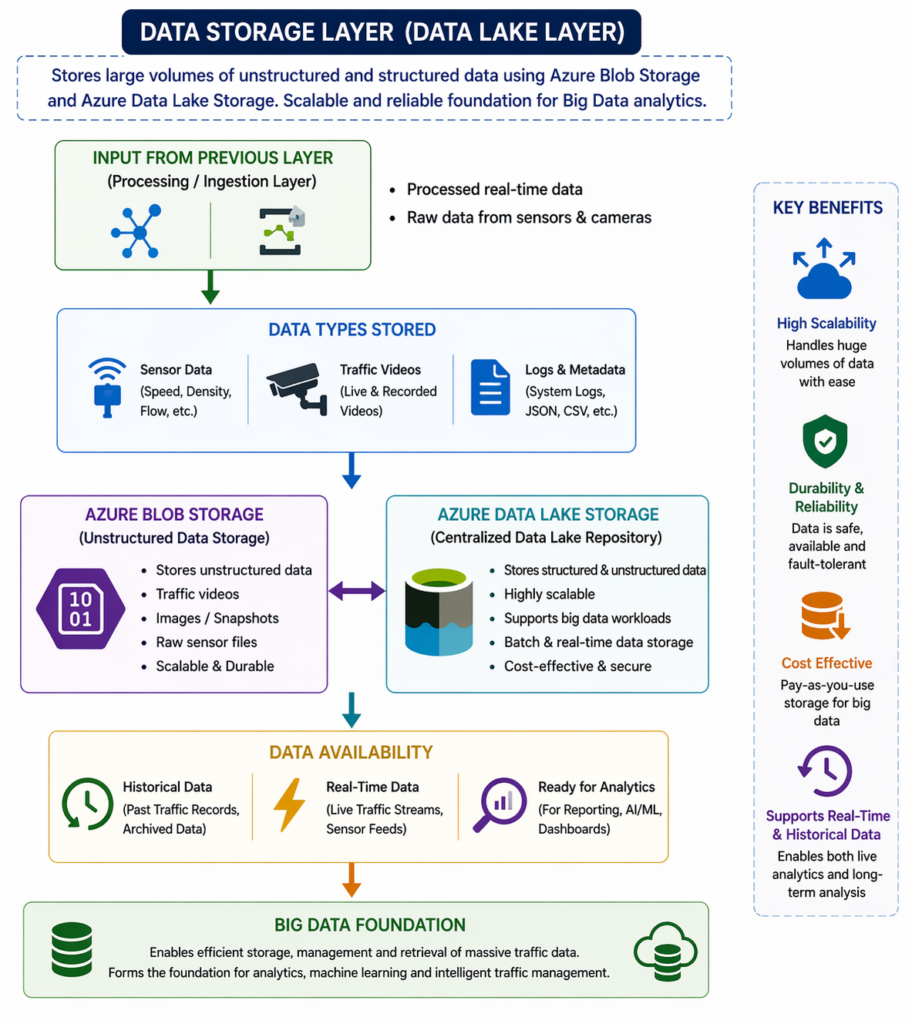
Data Processing and Analytics
Azure Synapse Analytics
Azure Synapse Analytics serves as the main analytics platform in the architecture. It enables the processing of both structured and unstructured data through SQL querying and big data analytics. In relation to the traffic system, Azure Synapse Analytics will be employed to determine the traffic flow, identify peak hours, and pinpoint areas of congestion. It integrates data warehousing and big data analytics in a single platform.
Azure Synapse Analytics is a powerful cloud-based analytics service that combines big data processing and data warehousing into a single unified platform. Its main characteristic is the ability to analyze both structured and unstructured data using tools like SQL and Apache Spark, making it highly flexible for different types of workloads.
Azure HDInsight
Azure HDInsight is a cloud-based platform that provides support for big data solutions such as Hadoop and Spark. The primary application of Azure HDInsight involves batch processing of big data collected from past experiences. In this case, HDInsight will be able to study traffic data over time to establish patterns such as which roads are most frequently traveled during particular days.
Azure HDInsight is a fully managed cloud service designed for processing large-scale big data using popular open-source frameworks such as Hadoop, Spark, Hive, and Kafka. One of its key characteristics is its ability to handle batch processing of massive datasets efficiently, making it suitable for analyzing historical data.
Azure Databricks
Databricks Azure is a powerful analytics platform built on top of Apache Spark. It is utilized for performing data processing and cleansing operations, as well as for developing machine learning algorithms. Specifically, in a smart traffic control system, Databricks helps process real-time data and build models predicting traffic jams. Thus, such a system can anticipate events instead of responding to them.
One of its main characteristics is high-speed data processing, enabling both real-time (streaming) and batch analytics with excellent performance. It provides a collaborative workspace where data engineers, data scientists, and analysts can work together using notebooks that support multiple languages such as Python, SQL.
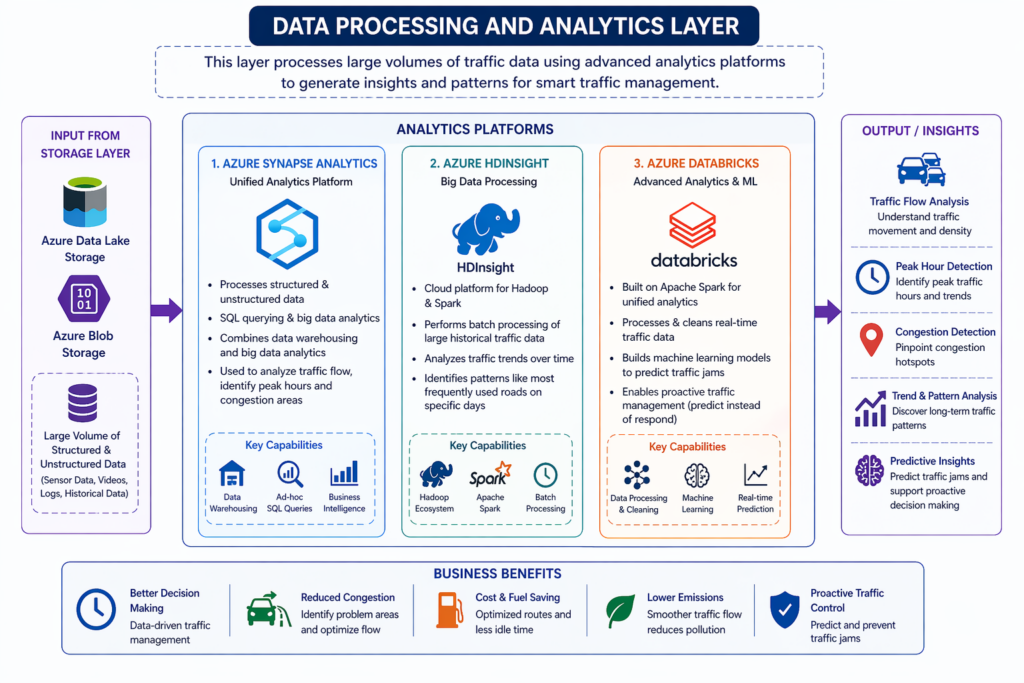
Synapse Pipeline (Data Integration)
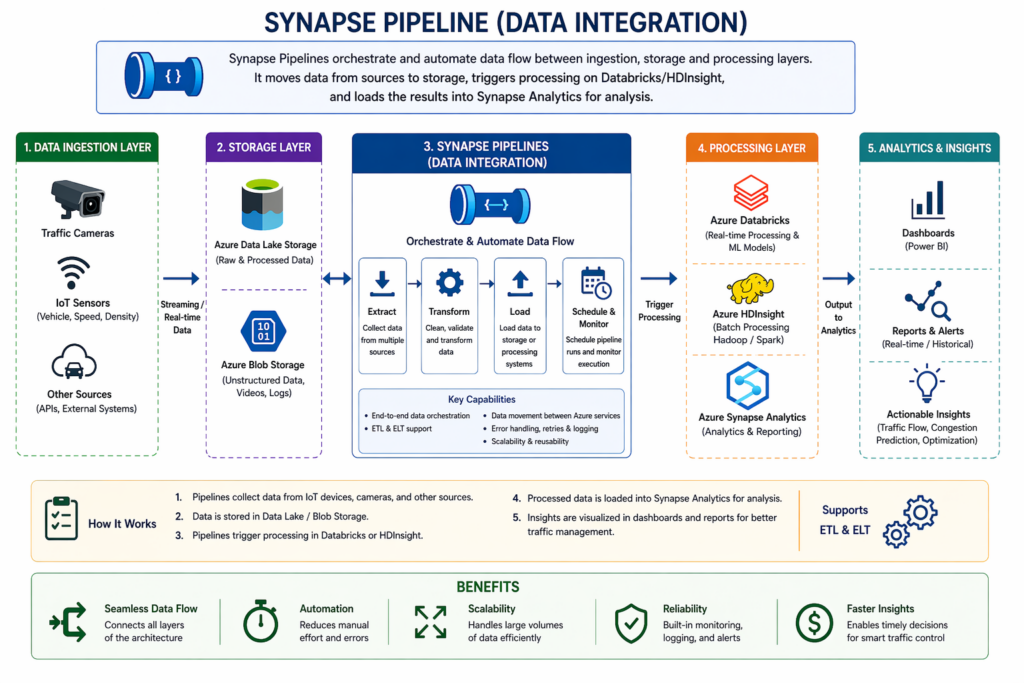
Pipelines are used to manage the data flow between different Azure services. Pipelines act as a bridge between the data ingestion layer, the storage layer, and the processing layer. For example, data collected from IoT devices is moved to the storage layer and processed using Databricks and HDInsight and then analyzed using Synapse Analytics.
One of its key characteristics is its ability to create end-to-end data pipelines that collect data from multiple sources, process it, and load it into storage or analytics systems. It supports ETL (Extract, Transform, Load) and ELT processes, making it useful for preparing data for analysis.
Intelligent Decision Making
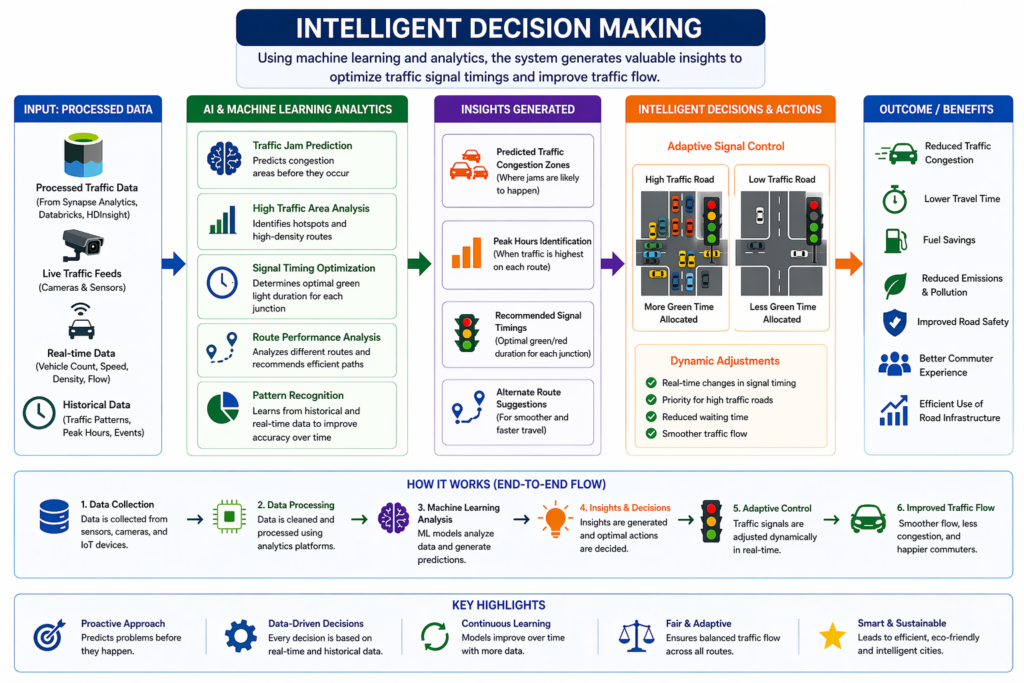
The analysis of processed data produces valuable insights which facilitate wise decision-making. By using machine learning algorithms, it is possible to anticipate traffic jam areas, analyze high-traffic areas, and determine suitable signal timings for various routes. The insight received helps to optimize the timings of the traffic lights accordingly and ensure more green lights on high traffic roads.
Data Visualization
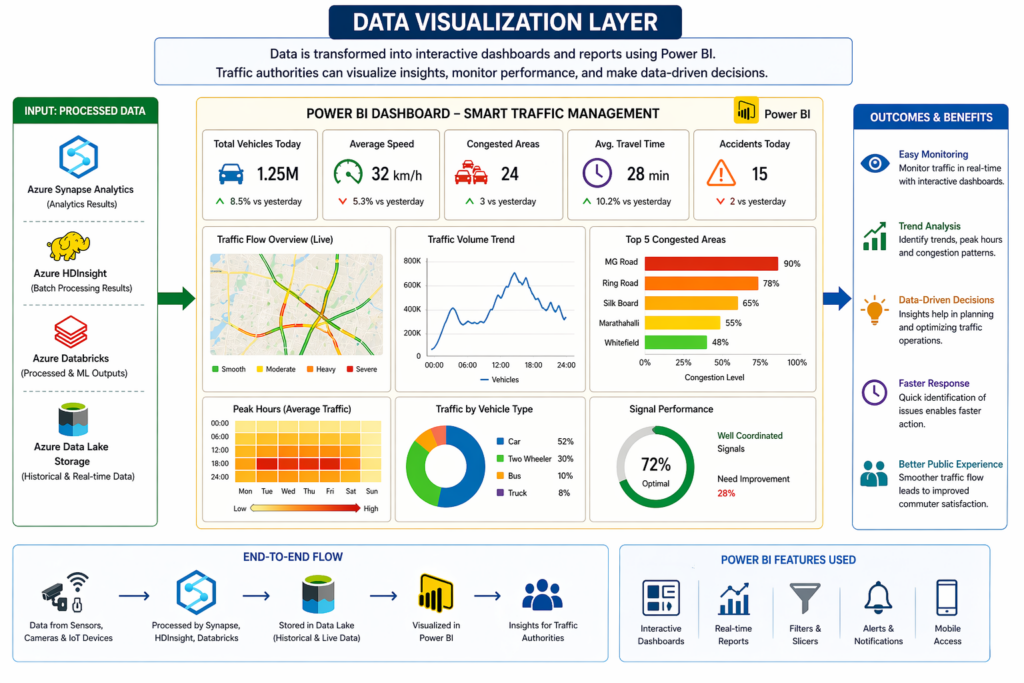
The last thing to do is to present the data in a readable format. The use of programs such as Power BI helps visualize the reports in the form of dashboard. Traffic authorities will be able to analyze trends based on the visualizations.
Conclusion
With the help of Azure technologies like Azure Synapse Analytics, Azure HDInsight, Azure Databricks, and Synapse Pipelines, it is possible to design an effective traffic management system. Such a system will enhance the efficiency of the traffic flow, reduce congestion, save fuel, and minimize pollution of the environment. All this illustrates that Azure Big Data and Analytics can address practical urban issues.