
The database services to be learned in this post are as follows:
- Azure Cosmos DB → Handles instantly
- Azure SQL Database → Manages reliably
- Azure Database for MySQL → Supports simply
- Azure Database for PostgreSQL → Analyzes deeply
Azure Cosmos DB
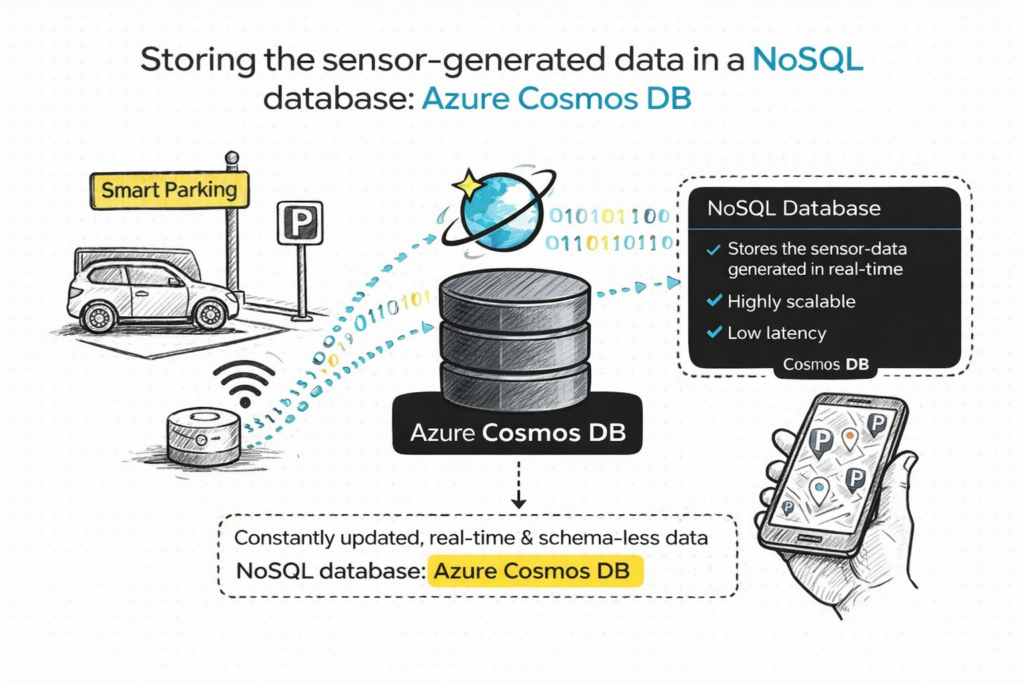
Let’s consider smart parking system in a busy city, which handles the real time and structured data. The data is generated by the sensors installed at parking lots. Every second, the sensors send the latest information about the state of the lot whether it is occupied or free. The data is constantly updated, generated in real-time, and does not have any schema. That is exactly what Microsoft has done in Azure Cosmos DB. The technology is capable of processing numerous updates in real-time while being highly scalable and featuring low latency, meaning that the updates become accessible to the users immediately.
Azure Cosmos DB is a fully managed NoSQL database service designed for modern applications that need speed, scalability, and global access. It is built for handling large-scale, real-time data efficiently.
Moving on to the mobile application employed by the drivers, it must be noted that when one opens the application, they want to get an immediate response regarding the vacant slots. This is facilitated in the application by Cosmos DB owing to the global distribution capabilities along with faster reads and writes. This ties well in with the notion of using Cosmos DB for real-time applications in the article.
For additional information https://learn.microsoft.com/en-us/azure/cosmos-db/overview
Azure SQL Database
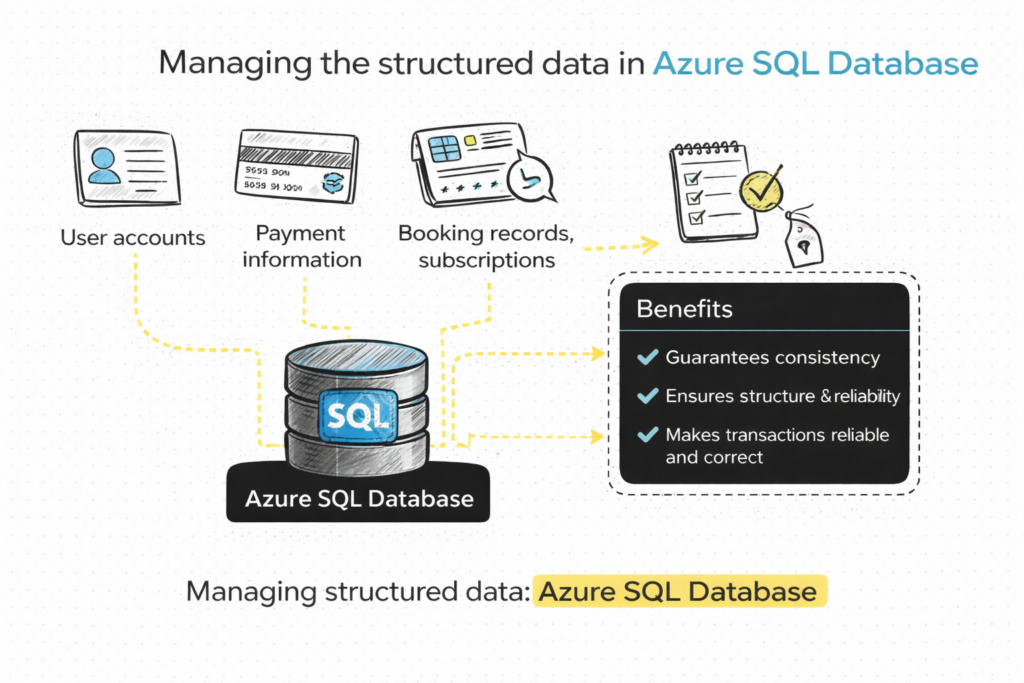
However, at the same time, there is a need for managing structured data, such as the user account, payment information, booking record, and subscriptions. Structured data has some relationship between tables, which means, for instance, that the user would have his or her bookings and payments linked. For this Azure SQL Database will be a good solution. The benefits of this database are that it guarantees consistency, structure, and reliability of data, and that will make transactions reliable and correct, just like ticket booking or inventory management from the example.
Azure Database for MySQL
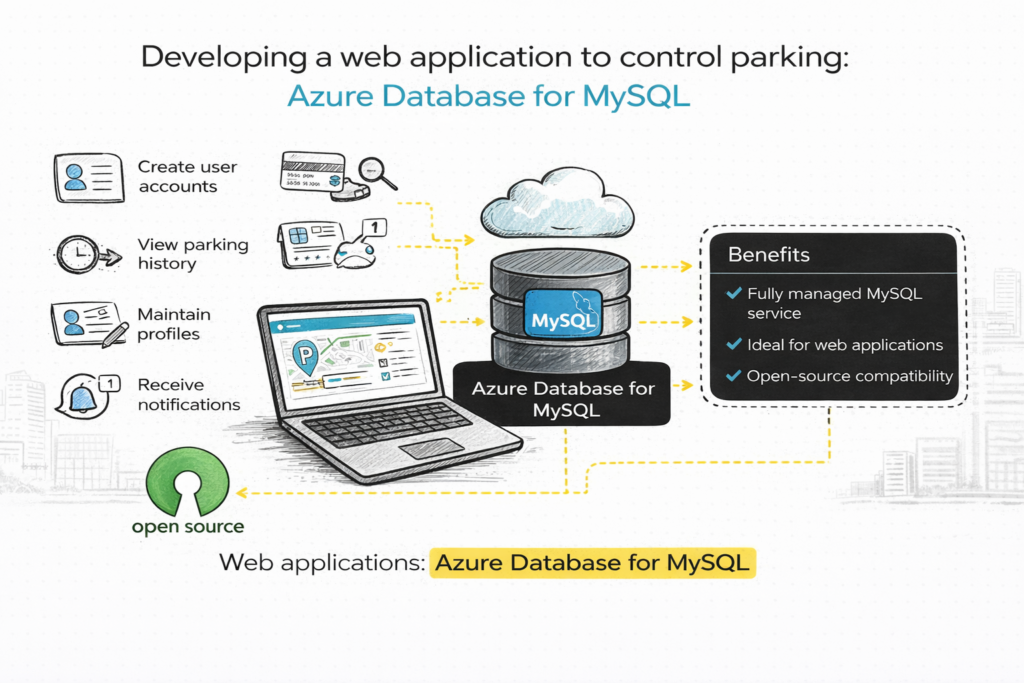
Imagine when we develop a web application for controlling the parking. This way, our application will provide features such as creating user accounts, viewing parking history, maintaining profiles, and even receiving notifications about certain changes. As such a kind of application will be quite similar to any other web application, we can expect the data model not to be very complicated. For this Azure Database for MySQL will be the best choice for us. It is known that the MySQL database is commonly employed in developing web applications due to its simplicity and low cost.
Azure Database for MySQL is a fully managed relational database service based on the MySQL engine. It is mainly used for web applications and systems that need structured data management. One of its main characteristics is open-source compatibility. Since it is based on MySQL, it easily supports existing MySQL applications without requiring major changes. This makes migration from on-premises MySQL systems very smooth.
Azure Database for PostgreSQL
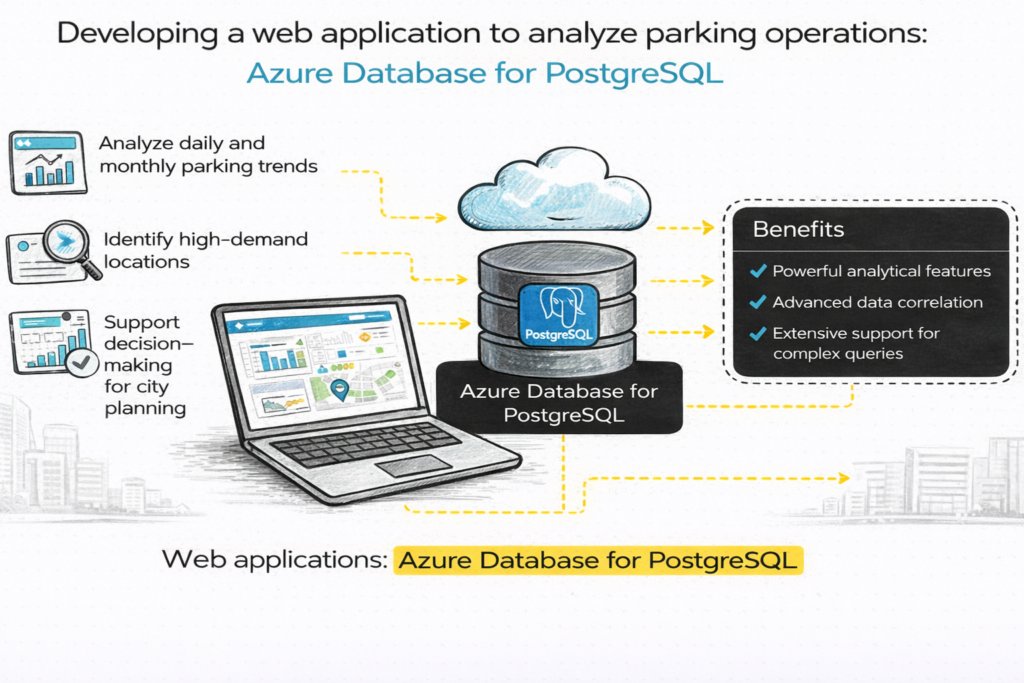
Let’s assume that the local government officials are looking forward to analyzing the parking operations. Some possible queries could include: Which are the busiest locations during specific periods? What is the average time of parking? These are definitely some challenging queries that require a lot of data and complicated correlation analyses to be conducted. For this Azure Database for PostgreSQL can do.
For example, PostgreSQL can help:
- Analyze daily and monthly parking trends
- Identify high-demand locations
- Support decision-making for city planning
Conclusion
This explains different types of Azure database services using a smart parking system example. It highlights how Azure Cosmos DB is used for handling real-time, unstructured sensor data with high scalability and low latency, while Azure SQL Database manages structured data like user accounts and transactions with reliability and consistency. It also describes Azure Database for MySQL as suitable for simple web applications due to its ease of use and compatibility and Azure Database for PostgreSQL for advanced data analysis and complex queries, helping in decision-making and insights generation.