
Topics covered in this post:
- Supervised Machine Learning
- Unsupervised Machine Learning
- Reinforcement Learning
Types of Machine Learning
Machine learning, abbreviated as ML, a growing field in the larger domain of Artificial Intelligence. It enables computers to make decisions without actually being programmed to make decisions. It has three different types: Supervised Learning, Unsupervised Learning, and Reinforcement Learning.
Important aspects of Artificial Intelligence are Machine Learning. Machine Learning is important because it enables machines to make opinions without interventions.
- Supervised Machine Learning
One of the most popular methods is supervised machine learning, in which the model learns from the data set provided to it. There’s a matching affair for each input in the data set. The algorithm learns to make prognostications by relating the input and affair.
Types of Supervised Learning:
Supervised learning can be of two types: classification and regression. Classification includes spam detection, in which the algorithm learns to identify spam and non-spam emails. Regression includes predicting the price of houses, in which the algorithm needs to learn the correlation and make predictions.
Example:
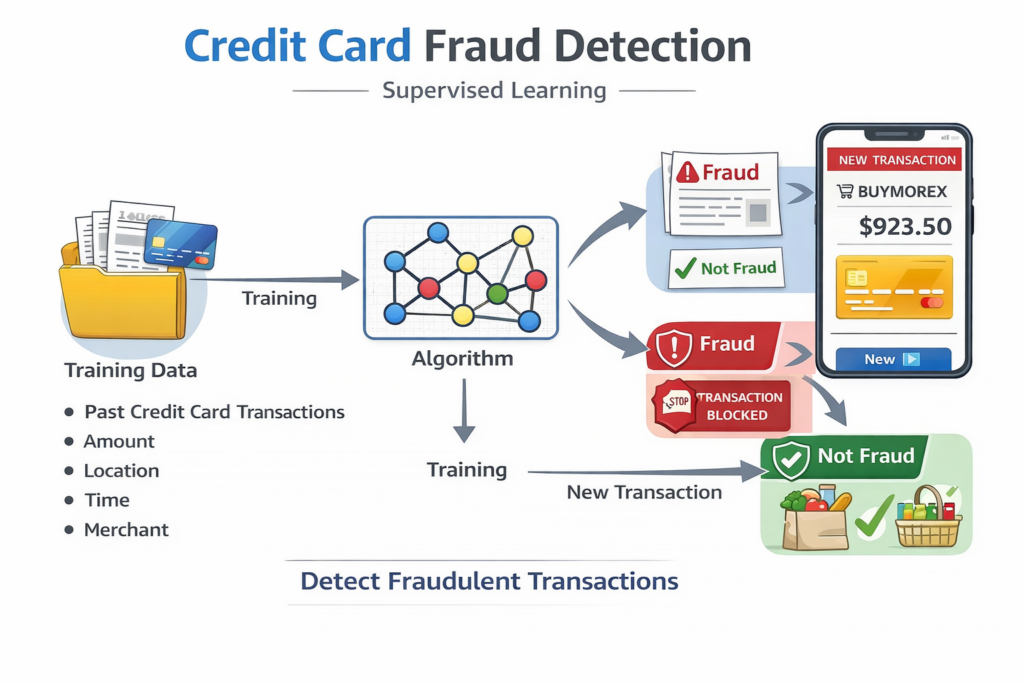
Credit Card Fraud Detection
This model is to determine whether the credit card is fraudulent or not.
- Training Data: The model is trained on a set of data that includes information on previous transactions. The transactions are categorized as ‘fraud’ and ‘not fraud’. The data includes transactions, the amount, location, time, and frequency.
- Learning Patterns: The model analyzes these features to find patterns that distinguish normal deals from fraudulent bones.
- Predictions: Once Trained, the model can estimate new deals in real time and prognosticate whether they are likely to be fraudulent.
- Action: If a sale is flagged as fraud, the bank can block it or warn the cardholder, precluding implicit losses.
2. Supervised Machine Learning
In unsupervised learning, the data is trained without any labels. The algorithm is trying to recognizes patterns and structures from the data provided.
The major methods include is clustering, in which the data is divided into clusters according to the patterns found in the data, k-means clustering, hierarchical clustering, association rule learning.
Example:
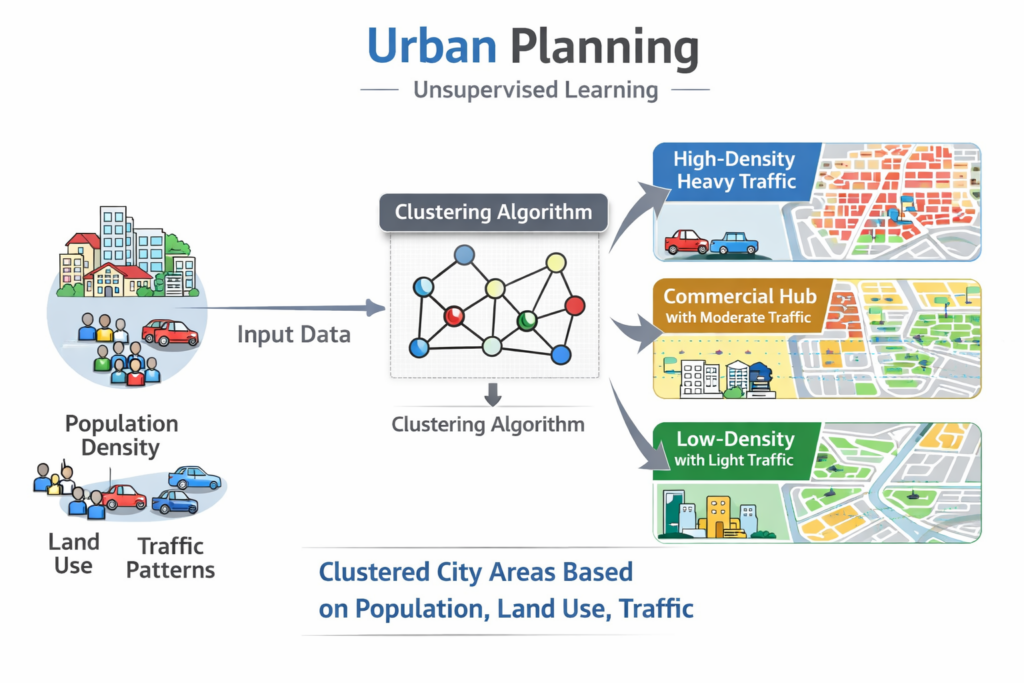
Urban Planning
City planners want to analyze and organize urban areas.
Data Collection: Planners gather data about different areas of the city, including features like population, traffic flow, types of land and public transport availability.
- Labels: Unlike supervise learning there are no predefined labels similar as “high precedence development” or “low precedence”. The model receives raw data.
- Clustering: An unsupervised algorithm, like K- Means or Hierarchical Clustering, analyzes the data to group areas with analogous characteristics. It produce clusters like
- High- viscosity domestic areas with heavy business
Insights and Planning: By identifying these natural clusters, city planners can make informed decisions about infrastructure, such as where to build new roads, parks, or public transport routes
3. Reinforcement Learning
The special form of machine learning, which is concerned with decision-making and interaction with the environment. The reinforcement learning method is based on the “agent” which learns to make decisions and interact with the environment, and the feedback it receives is called “reward” or “penalty.”
The major components of reinforcement learning are as follows:
- Agent: The learner or the robot/self-driving car.
- Environment: Everything the agent interacts with (roads, business).
- Actions: Choices the agent can make (accelerate, turn,).
- Reward: price Positive feedback
- Penalty: Negative feedback for bad conduct (breaking business rules).
- Policy: The strategy developed by the agent to take conduct that affect in maximum price.
One of the greatest advantages of reinforcement learning is its ability to learn from changing conditions.
Example:
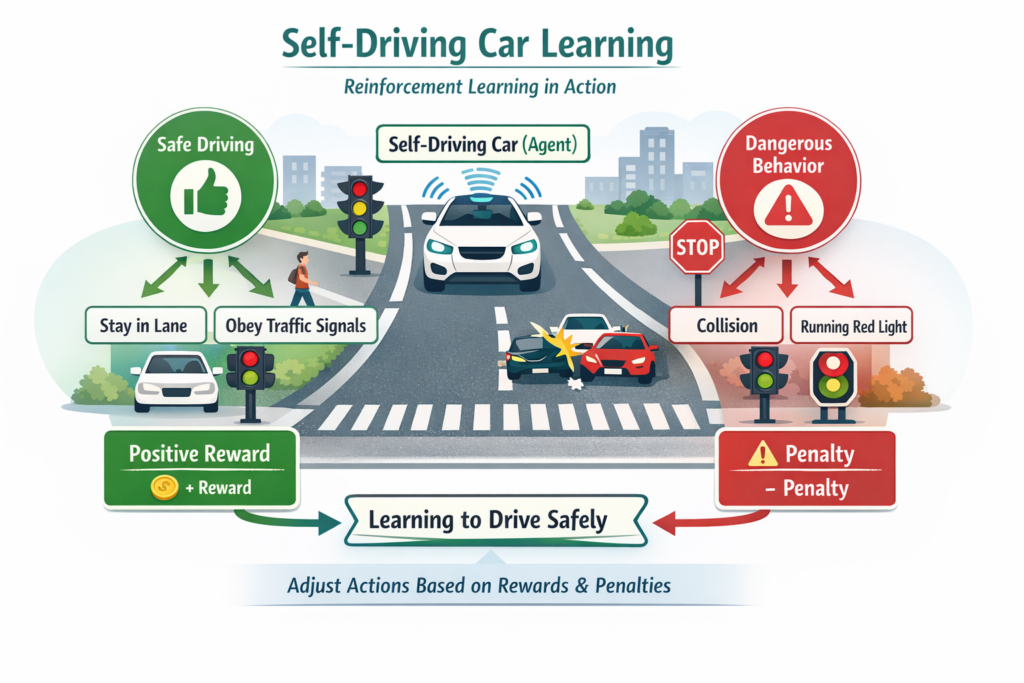
Self-Driving Cars
- Agent and Environment:
- The self-driving car is the agent.
- The environment includes the road, traffic, traffic signals.
- Action: The conduct the auto can perform are accelerate, turn left etc.
- Rewards and Penalties:
- Positive rewards are given for safe driving behaviors, such as staying in the lane, obeying traffic rules.
- Penalties are given for unsafe conduct, like collisions or unforeseen or sudden braking that could endanger passengers.
- Learning Process:
- The auto uses trial and error in simulations or controlled surroundings to learn
which conduct maximize accretive prices. - The system learns safe driving strategies that balance speed and safety.
- Outcome: The auto becomes able of navigating real-world roads while making independent opinions that maximize safety and performance
Conclusion
To conclude on the aspects of artificial intelligence is machine learning, which is aimed at assisting the machine in making intelligent opinions where the machine is suitable to learn from experience without being programmed. There are three main aspects of machine learning, which include supervised learning, where the machine is suitable to learn from its experience to make decisions. The second is unsupervised learning, where the machine is able to analyze the experiences and learn from the experiences, and able to identify the patterns. The third is reinforcement learning, where a machine is able to make sequential decisions.